At Wpromote x Giant Spoon, we use AI marketing tools like Profound to monitor AI search visibility for brands across more than 100 categories, from retail to software to travel. One question comes up in almost every client conversation: does social media actually influence AI search?
The short answer is yes, though not always in the way brands expect. Reddit gets most of the attention, but it’s one part of the picture. The social and community content we see surfaced in AI looks more like an ecosystem: video explainers, public community groups, review platforms, expert posts, and creator content, each carrying different weight by category and by AI engine.
A clear pattern runs underneath. AI engines tend to cite community content that’s public, specific, and evidence-rich. On the flip side, they largely pass over gated or generic content. Not all of the influence is direct, either:
- Direct influence: the platform itself appears as a cited source in the AI answer.
- Indirect influence: social conversations shape the language, associations, and stories that publishers repeat, and AI engines cite those publishers.
This is the first edition of Wpromote x Giant Spoon’s quarterly AI Search Trends Report. Every quarter, we’ll go deep on one relevant AI search theme to help marketers stay current as AI search changes. Below are the eight social and community trends we’re seeing right now across ten verticals, what’s driving them, and what they mean for brands.
1. YouTube Is the Most Consistently Cited Social Source
YouTube matched or beat Reddit’s citation share in every category we track but one. In financial software, it was the single most-cited domain, ahead of every publisher and software brand.
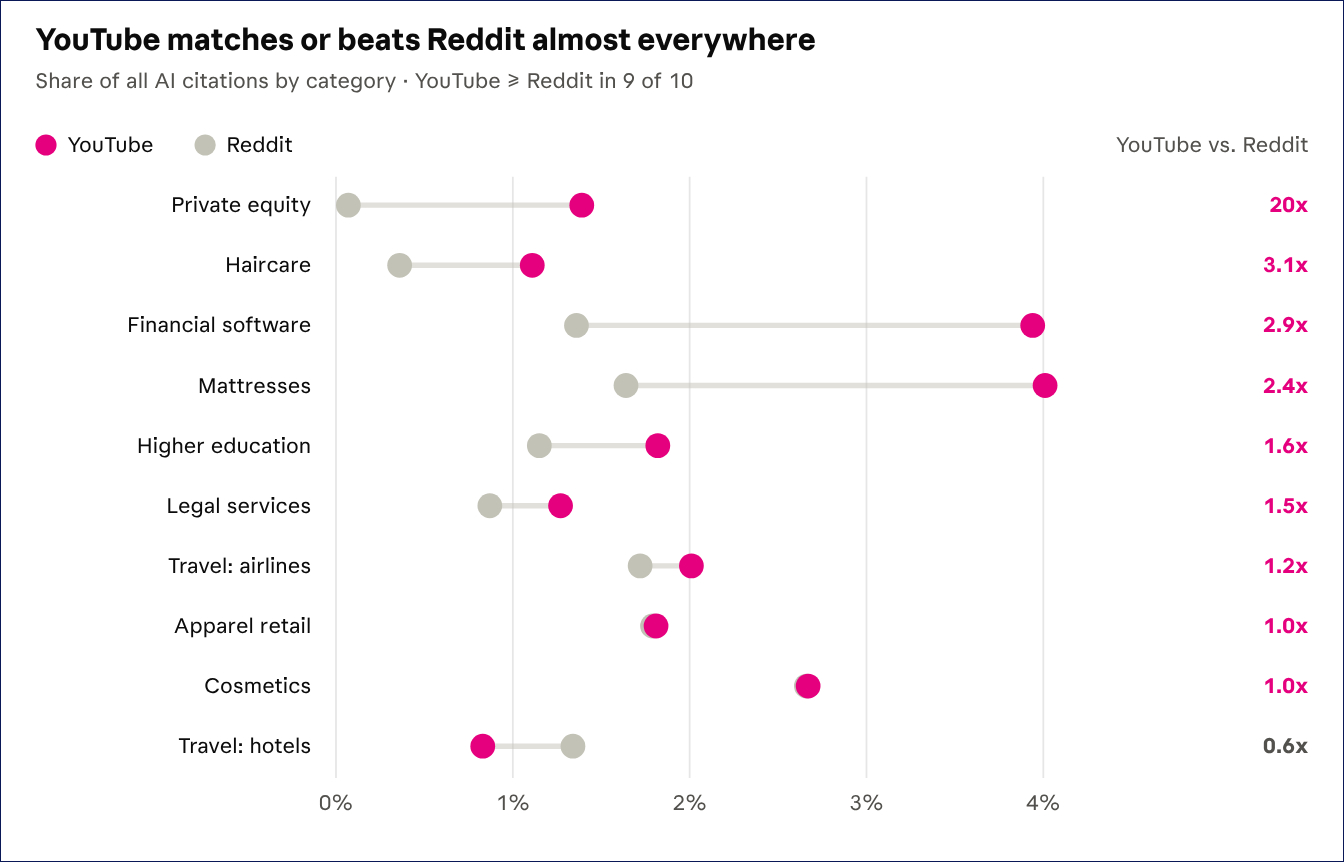
YouTube is at its most influential where buyers need something explained or demonstrated. It ranks #4 among all cited domains in mattresses and legal services, and #3 in higher education. Hotel questions in travel are the one exception, where Reddit and Tripadvisor carry the trip reports.
The engine matters as much as the platform. In cosmetics, YouTube makes up 9.5% of Google AI Overviews’ citations but just 0.03% of ChatGPT’s, which means video is a Google-ecosystem play first for many marketers.
What this means for marketers
Treat YouTube as search content, not brand content. Explainers, comparisons, and how-tos that answer a real buyer question are what get pulled into AI answers. One caution: earlier snapshots still showed Reddit ahead in categories like activewear and fine jewelry, so check your own vertical before shifting budget.
2. Facebook Groups Are a Sleeper Source
For airline questions in travel, Facebook was the #8 most-cited domain overall, ahead of Reddit at #10. The citations come largely from public groups, not brand pages.
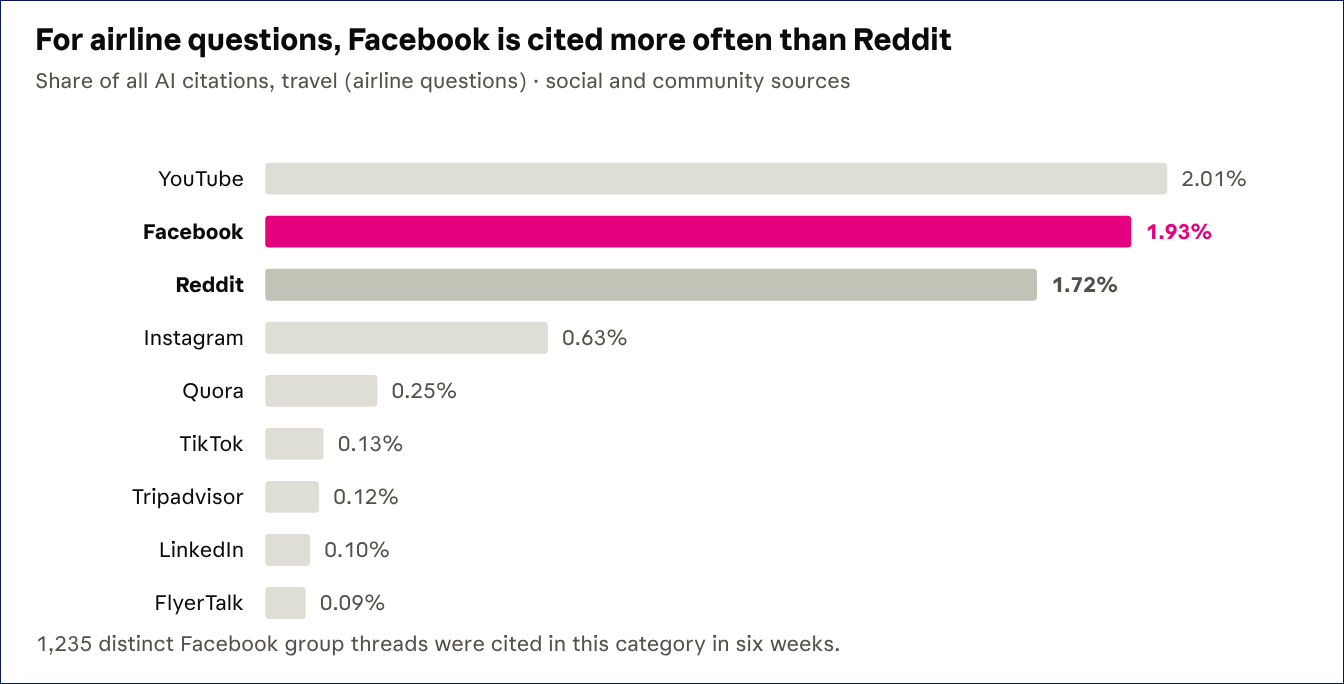
Many of the cited threads come from loyalty and perk communities, like fan groups built around a single carrier’s program benefit. Members there trade detailed, first-hand answers about how a program actually works, which is exactly the real-world evidence AI engines seek out.
The pattern goes beyond airlines. Facebook ranks #10 among all cited domains for hotel questions and #14 in higher education.
What this means for marketers
Map the public groups where your customers trade advice, and treat them like search results. Brands can’t post their way into these communities, but they can ensure accurate answers exist there through community managers, ambassadors, and real customer support. Private groups are invisible to AI, so only public conversations count.
3. Category-Specific Review Platforms Beat Generic Ones
AI engines trust review platforms built for a single category far more than review sites built for everything. In financial software, G2 is the #6 most-cited domain overall. Together, G2 and Capterra earn 2.3% of all citations, 1.7x Reddit’s share.
This is true in travel, too. Tripadvisor ranks #8 among all cited domains for hotel questions, just behind Reddit. Trustpilot, by contrast, stayed under 0.05% share in every category we checked.
The difference is structure. Specialist platforms often organize reviews by use case, company size, and feature, which maps neatly onto the comparison questions people ask AI. A generic star rating answers almost none of them.
What this means for marketers
A review program aimed at the platforms AI already cites in your category will outperform a volume play on generic sites. Whenever possible, ask reviewers to describe the specific problem they solved, because that language is what gets retrieved.
4. LinkedIn Wins in B2B, and It’s People, Not Pages
In private equity, LinkedIn is the #19 most-cited domain overall, while Reddit sits at #279. Outside B2B, LinkedIn barely registers.
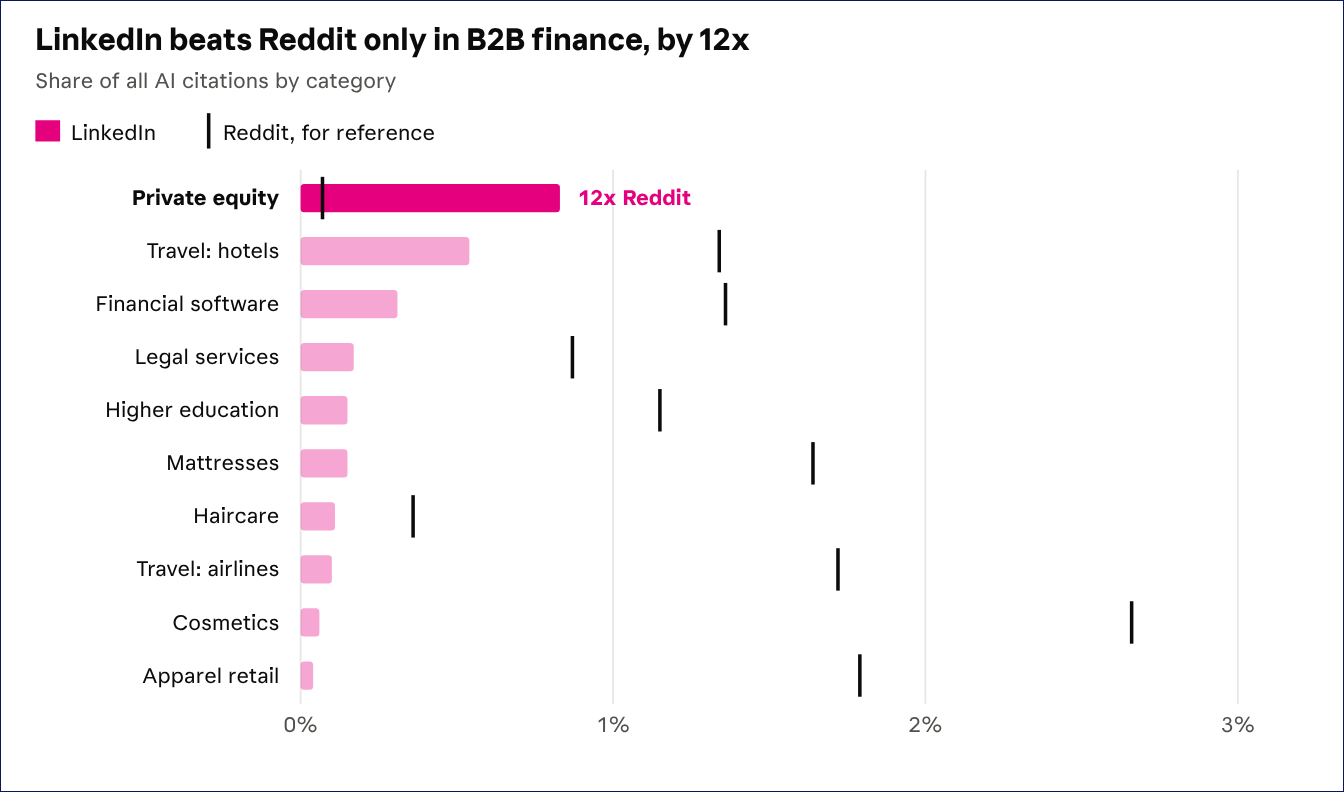
What gets cited is individual expertise. AI engines cited 248 distinct LinkedIn URLs in private equity, and sixteen of the top twenty were Pulse articles or personal posts. Company pages were a small minority.
Hotel travel is the exception. LinkedIn ranks #17 there, likely because hospitality buyers include corporate travel and events planners who research on LinkedIn.
What this means for marketers
For B2B brands, thought leadership from executives and practitioners can be some of the most valuable AI search content. Long-form Pulse articles that answer a specific industry question do the work. For consumer brands, LinkedIn isn’t a reliable AI search play.
5. Individual Creators Can Outweigh Entire Platforms
In cosmetics, one beauty creator’s Substack review of tubing mascaras was cited 153 times in six weeks. That single page earned more citations than all of Quora, Pinterest, LinkedIn, or X in the category.
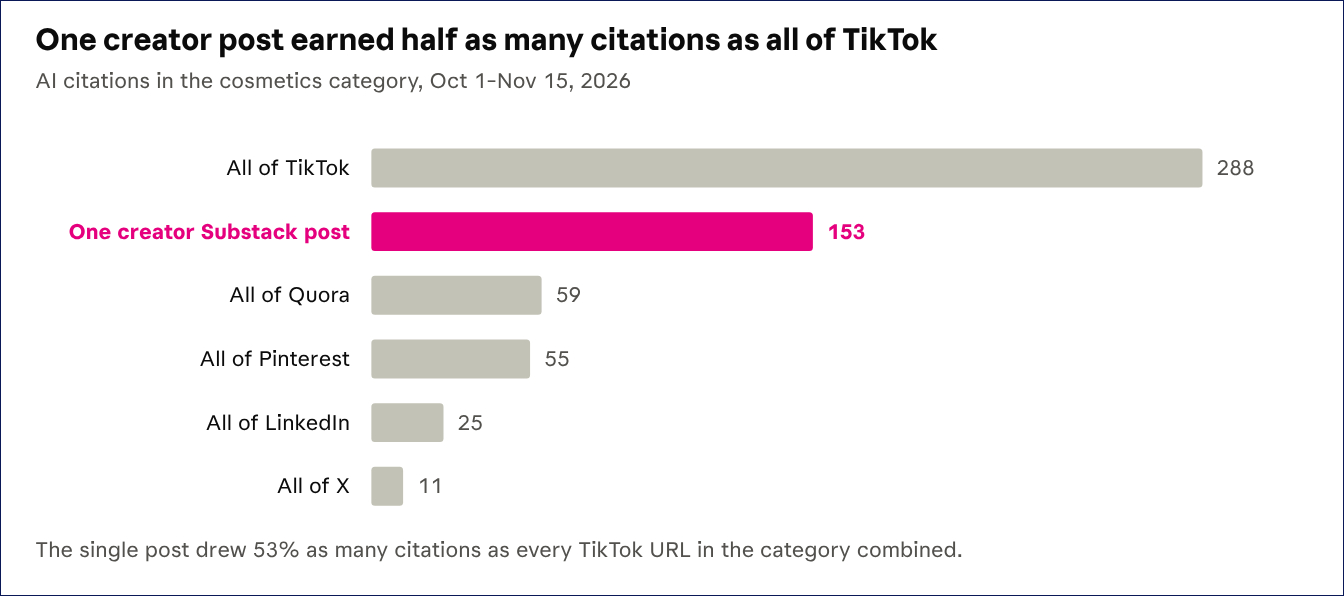
The post works because it does what AI engines need: it names specific products, compares them on clear criteria, and gives a first-hand verdict. Substack overall ranks #70 among cited domains in cosmetics, ahead of every platform in the above chart except TikTok.
Visual platforms show the same creator pull. In haircare, Instagram is cited more often than Reddit, and Instagram’s share of apparel citations grew 8x between July 2025 and October 2026.
What this means for marketers
Creator partnerships should be judged partly on whether the content will be retrievable. A detailed, text-based review on an open platform can keep earning AI citations long after a sponsored story expires. When briefing content creators, ask them to compare options, name products, and explain their reasoning.
6. TikTok Works Indirectly, and Mostly on Google
TikTok is rarely cited directly. Its best showing across our categories was in cosmetics, at 0.33% of all citations. In financial software, it was only cited eleven times in six weeks.
Where TikTok does get cited, it’s almost entirely a Google story. In our data, we saw that Google AI Mode cited TikTok 28x more often than ChatGPT did:
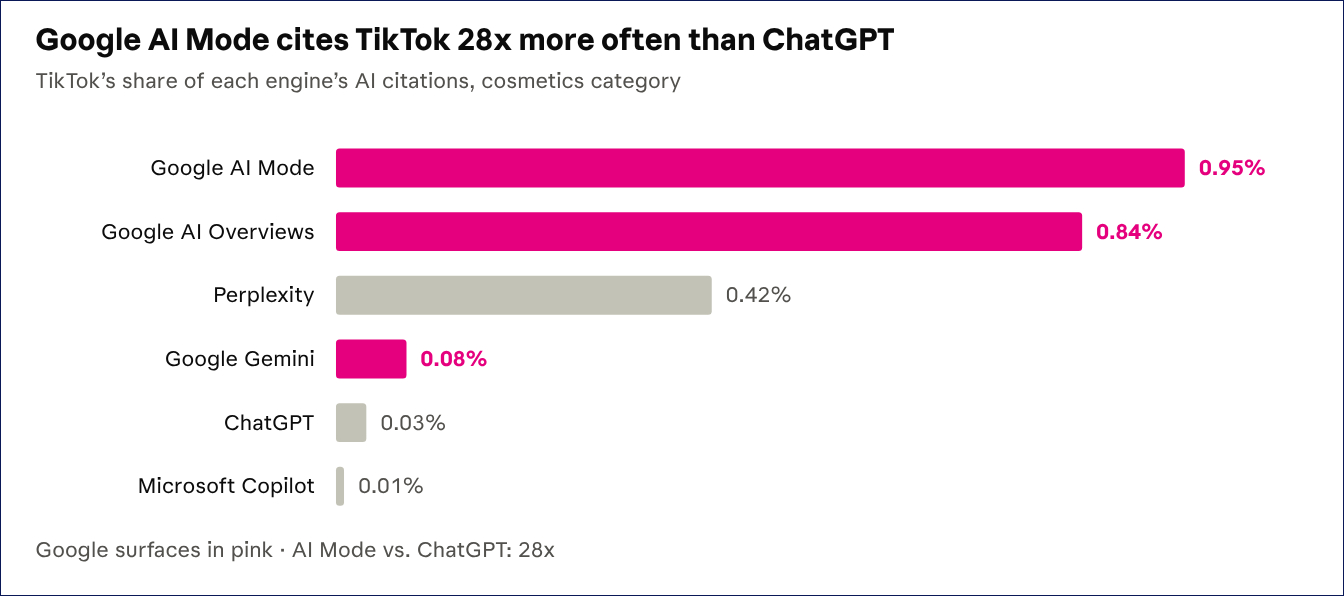
TikTok’s bigger effect is second-hand. In apparel, a Business of Fashion article on TikTok-native activewear brands was cited twenty-six times in six weeks, about a fifth as many citations as tiktok.com itself earned. Viral moments reach AI answers when publishers write them up.
What this means for marketers
If you measure only using direct AI citations, you might be missing a big piece of why short-form video is valuable. Measure it by whether it creates the trend, phrase, or product moment that publishers then cover. If Google AI surfaces matter most in your category, TikTok can also earn some direct visibility there.
7. For Chatgpt, Social Influence Arrives through Publishers
ChatGPT rarely cites social platforms directly: 0.7% of its citations in both cosmetics and apparel came from social media sources. Google’s AI surfaces cite social twenty-five to thirty-three times more often.
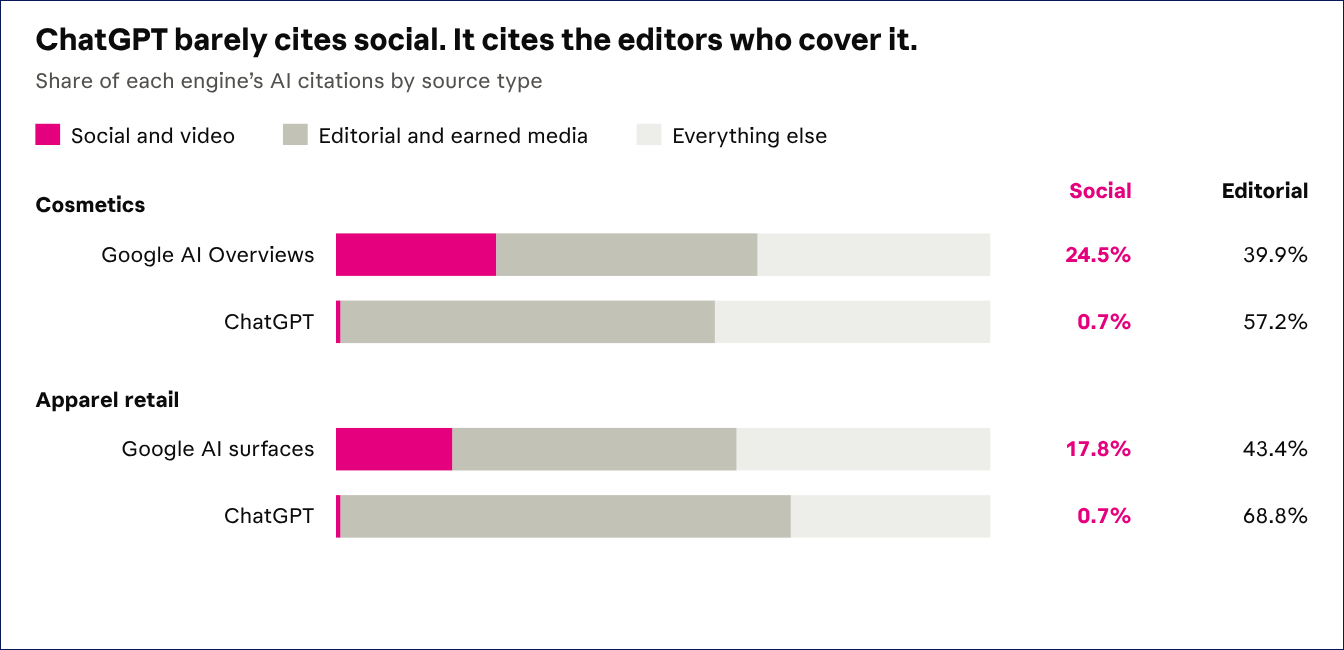
That doesn’t mean social is irrelevant to ChatGPT, but it does mean the path is longer. ChatGPT leans on fashion and beauty editors like Vogue and Who What Wear, which lead its citations in the apparel category. Those editors cover what’s trending on social platforms, meaning a social post is often most effective when bubbled up through a platform that ChatGPT considers more authoritative.
ChatGPT shows indirect influence most clearly. A creator moment, a viral product, or a recurring community complaint becomes a ChatGPT citation once a publisher writes it up.
What this means for marketers
Connect social and digital PR. When a product or phrase takes off on social, pitch the story to the publications AI engines cite in your category. Track which social moments earn editorial pickup, not just engagement.
8. Gated Communities Are Invisible, and Expert Answers Beat Enthusiast Chatter
Across the seven categories we tracked, Discord was cited exactly once in six weeks. Conversations behind a login are effectively invisible to AI engines, no matter how active the community is.
Open communities, like discussion forums and message boards, split by the kind of answers they hold:
- Expert Q&A wins. In legal services, Avvo (#20 among cited domains) and JustAnswer together out-drew Reddit, 0.92% to 0.87%. Both are built around answers from credentialed professionals.
- Quora drew only a modest number of citations. Its best showing was #51 in travel.
- Enthusiast forums lag. FlyerTalk ranked around #100 to #130 in travel. College Confidential ranked #700 in higher education.
What this means for marketers
Community programs on Discord or in private Slack groups build loyalty, but they won’t build AI visibility. If you want a community to show up in AI answers, make its highest-quality and most relevant content public and searchable, and make sure credible experts are answering.
What To Do: Build For Direct and Indirect Influence
The brands that win treat social and community as two jobs, each measured differently. Not every post needs to earn a citation, but every program should know which job it’s doing.
|
Direct influence |
Indirect influence |
|
|
How it works |
The platform itself is cited in the AI answer |
Social shapes the language and stories publishers repeat; AI cites the publishers |
|
Where it happens |
YouTube, public Facebook groups, category review platforms, LinkedIn (B2B), creator blogs and newsletters |
TikTok, Instagram trends, viral product moments, recurring community conversations |
|
Which engines |
Mostly Google AI Overviews, AI Mode, and Perplexity |
ChatGPT especially, through the editorial sources it favors |
|
What to create |
Searchable explainers, comparisons, detailed reviews, expert answers |
Moments worth covering, plus PR that carries them to the right publishers |
|
How to measure |
Citation share by platform and engine |
Editorial pickup, and the brand associations that show up in AI answers |
Four Moves to Build Your AI Visibility through Social Platforms
- Audit your category’s citation mix. Find out which social and community domains AI engines actually cite for your buyers’ questions. The answer differs by category and by AI platform.
- Turn YouTube into search content. Answer the questions that buyers ask AI, with titles and descriptions that clearly state the question each video answers.
- Show up where customers already answer each other. That can include public social media groups, category review platforms, and expert Q&A sites.
- Make sure your social platforms are wired into digital PR. When something takes off, get it in front of the publications that AI engines cite.
Want to see how social and community content shapes your brand’s AI visibility? Request an AI Visibility audit.
About the Data
All findings come from Profound citation data tracked by Wpromote x Giant Spoon, covering nine to eleven AI engines per category, including ChatGPT, Google AI Overviews, Google AI Mode, Gemini, Perplexity, and Microsoft Copilot.
- Window: October 1 to November 15, 2026.
- Categories: apparel retail, cosmetics, haircare, mattresses, airline, hotels, financial software, private equity, legal services, and higher education.
- Share of citations: Profound’s citation share, averaged across AI engines so that each engine counts equally. Ranks are among all cited domains in the category, not just social platforms.